
'...the enormous responsibility and faith the youth has put on his shoulders, that he is going to solve their problems.'

'India cannot speak of a demographic dividend if half its young women are unable to participate in paid work.'

The Royal Swedish Academy of Sciences has decided to award the Sveriges Riksbank Prize in Economic Sciences in Memory of Alfred Nobel 2021 with one half to David Card "for his empirical contributions to labour economics" and the other half jointly to Joshua Angrist and Guido Imbens "for their methodological contributions to the analysis of causal relationships". Card is the Class of 1950 Professor of Economics at the University of California, Berkeley and Director of the Labor Studies Program at the National Bureau of Economic Research. Angrist is an Israeli American economist and Ford Professor of Economics at the Massachusetts Institute of Technology. Imbens is Professor of Economics at the Stanford Graduate School of Business since 2012. After earning his Ph.D. from Brown University in 1991, he taught at Harvard University, UCLA, and UC Berkeley.

Bookstore owners were cautioned against keeping or distributing the books. Police personnel briefed the bookstore owners about the legal consequences of violating the ban.
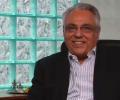
Diwan Arun Nanda, founder of Rediffusion and one of India's last great admen, changed the industry with memorable campaigns, political ads, and a rare mix of sharp strategy and creativity.

"I am very happy and proud of his achievements. I am yet to speak to him. I think he must be sleeping as it's still night in the United States," she said.

Carter was in politics, but not a politician, certainly not a transactional politician, points out Shreekant Sambrani.

Banerjee, 58, was educated at the University of Calcutta, Jawaharlal Nehru University and Harvard University, where he received his Ph.D in 1988. He is currently the Ford Foundation International Professor of Economics at the Massachusetts Institute of Technology.
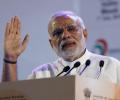
Modi denies the charges and was exonerated in an Indian Supreme Court inquiry in 2012.

Amartya Sen was the other Presidency alumni to win the Economics Nobel. Banerjee won the 2019 Nobel Economics Prize along with two others - his wife Esther Duflo and Michael Kremer on Monday "for their experimental approach to alleviating global poverty."

The IP & Science business of Thomson Reuters has announced its 2013 "Nobel-class" Citation Laureates on Wednesday, which names 28 researchers representing 22 distinct academic and research organisations, and six different countries.

On Monday, the Royal Swedish Academy of Sciences announced that Abhijit Banerjee, Esther Duflo and Michael Kremer had won the 2019 Nobel Prize for economics "for their experimental approach to alleviating global poverty". The research conducted by them has considerably improved the ability to fight global poverty. In just two decades, their new experiment-based approach has transformed development economics, which is now a flourishing field of research, said the Royal Swedish Academy of Sciences. Here are some interesting facts about the Indian-origin Abhijit Banerjee.

By thinking about growth versus poverty we have missed the main point, says MIT professor Abhijit Banerjee.

Indian-American economist Abhijit Banerjee and his French-American wife Esther Duflo along with their colleague Michael Kremer received the 2019 Nobel Prize in Economic Sciences on Tuesday for their work to alleviate global poverty that has helped millions of children in an experimental approach that favours practical steps over theory.

MIT, in a release, said the 'work of Duflo and Banerjee has emphasised the use of field experiments in research, to bring the principles of laboratory-style randomised, controlled trials to empirical economics'.

Lloyd and Sussane Rudolph -- two University of Chicago professors who started studying Indian politics in the 1950s, have been named the winners of the Padma Bhushan Award.

From his economist mother to politicians and academia -- all hailed Banerjee's achievement.

Banerjee joins the list of Indians and people of Indian origin who have received the prestigious Nobel prize in fields like Physics, Chemistry, Peace, Economic Sciences and Medicine.

'In the last five-six years, at least we could witness some growth, but now that assurance is also gone,' Banerjee told a news channel from the US.

The West Bengal chief minister during the meet said that the state government was keen to utilise the Nobel winner's services.

Rahul Gandhi said he had helped the party conceptualise its 'Nyay' scheme to help remonetise the economy.

"Excellent meeting with Nobel Laureate Abhijit Banerjee. His passion towards human empowerment is clearly visible. We had a healthy and extensive interaction on various subjects. India is proud of his accomplishments. Wishing him the very best for his future endeavours," Modi said in a tweet, sharing a picture of their meeting at his official residence.

The American university, once the envy of the world, is in crisis, notes Ajit Balakrishnan in his latest column.

What does Nobel Laureate Abhijit Banerjee thinks about India's education sector?

Can we make high speed 4G Internet available at 10 cents per GB, and make all voice calls free of cost -- that too in a large and diverse country like India? Can we make high-quality but simple breast cancer screening available to every woman, that too at the extremely affordable cost of $1 per scan? Can we make a portable, high-tech ECG machine which can provide reports immediately and that too at the cost of 8 cents a test? Can we make an eye imaging device that is portable, non-invasive and costs 3 times less that conventional devices? Can we make a robust test for mosquito-borne dengue, which can detect the disease on day 1, and that too at the cost of $2 per test? Amazingly, says Dr R A Mashelkar, the eminent scientist, all this has been achieved in India, not only by using technological innovation but also non-technological innovation.

50 years ago, on April 1, 1968, Tata Consultancy Services -- now India's leading IT company -- was born. The foundation for TCS was laid by Faqir Chand Kohli whose life touched directly or indirectly many, many, Indians, says Shivanand Kanavi.
.jpg)
Rohan Murty was speaking at the 50th anniversary symposium of the computer science department at Cornell University.
